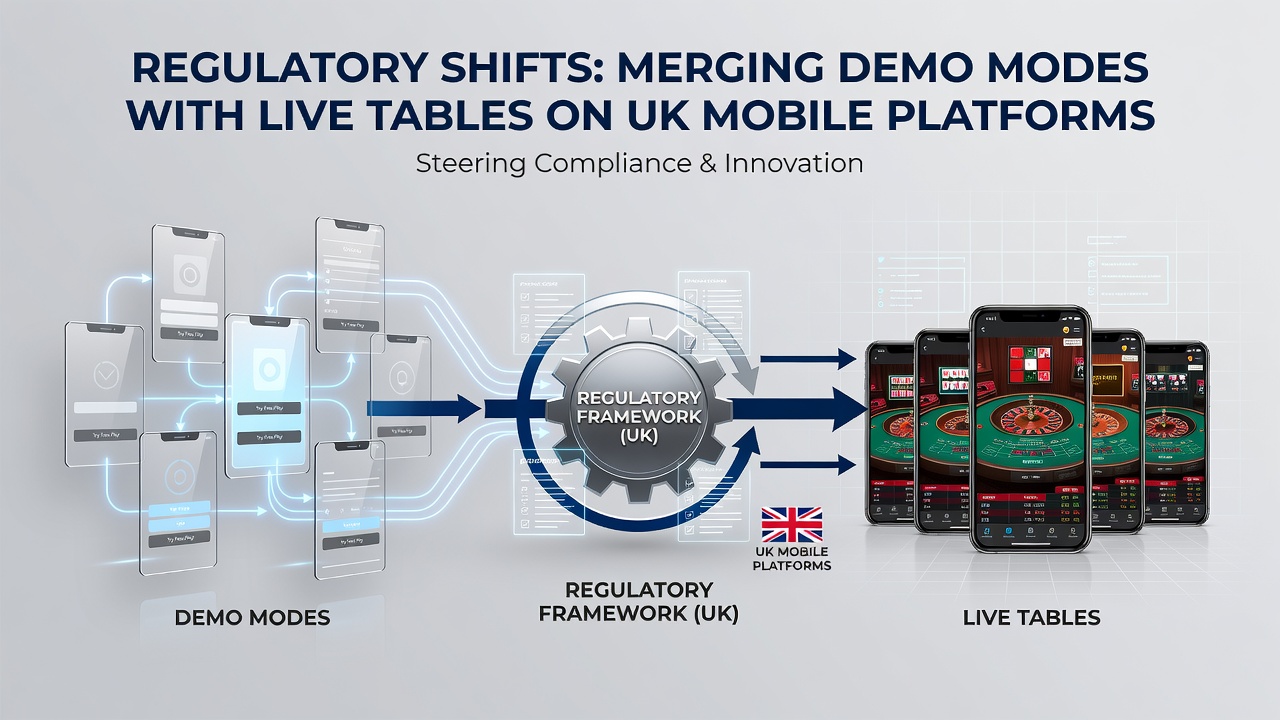
Regulatory Shifts Integrating Demo Modes into Live Table Experiences on UK Mobile Platforms
Regulatory adjustments across European jurisdictions have begun steering operators toward combining practice environments with real-time dealer tables on mobile applications, and this pattern has gained momentum in the United Kingdom since early 2025. Data from industry monitoring services shows that mobile traffic now accounts for over 70 percent of all online table activity, which has prompted authorities to examine how demo functions can sit alongside live streams without creating separate compliance layers. Observers note that seamless transitions between practice rounds and actual bets reduce friction for users while allowing continuous verification of age and location controls.
Background on Demo and Live Integration Trends
Demo modes have long served as entry points that let individuals test rules and interfaces before committing funds, yet separate systems often created duplicated data handling requirements. Researchers at several European academic institutions found that unified platforms cut redundant logging processes by approximately 35 percent in controlled trials conducted during 2024. Because live tables already transmit video and bet data in real time, regulators have explored whether embedding limited demo credits within the same feed could simplify audit trails without expanding server infrastructure.
Operators have responded by developing middleware that pauses live participation when a user switches to practice mode, and this approach maintains session continuity while satisfying transparency rules. Figures released by the European Gaming and Betting Association indicate that such middleware deployments increased by 22 percent among major platforms between January and June 2025. Those who manage mobile applications report that the single-interface model also lowers customer support queries related to account navigation.
Key Regulatory Developments Through Mid-2026
By August 2026 several updated guidelines from multiple national bodies are scheduled to take effect, and these changes emphasize proportionate risk management for integrated features. One clause requires that demo balances remain clearly distinguishable from real funds through visual cues and transaction logs, while another directs operators to apply the same responsible gaming prompts in both modes. Analysts tracking policy releases across the continent have documented that similar language appears in draft texts issued by regulators in Ireland, the Netherlands, and parts of Scandinavia, suggesting a harmonization trend that could ease cross-border operations.
Industry reports further reveal that testing protocols now include stress checks for latency when users toggle between demo and live states on 5G networks. Because mobile connections fluctuate more than fixed broadband, authorities have asked providers to demonstrate sub-second failover capabilities during certification renewals. Data compiled by independent testing laboratories shows average latency reductions of 18 milliseconds in platforms that adopted the new toggle architecture ahead of deadlines.

Technical adn Operational Adjustments on Mobile Platforms
Developers have introduced containerized modules that isolate demo sessions within the same application binary used for live tables, and this structure permits rapid updates without full app store resubmissions. Studies conducted by university engineering departments indicate that container isolation reduces memory overhead by nearly 40 percent compared with legacy dual-app approaches. Platform teams have also embedded geofencing logic that activates identical verification sequences regardless of whether a user enters via demo or funded play.
Payment processors have adapted their APIs to recognize demo-to-live transitions as single events rather than separate authorizations, which cuts processing fees and simplifies reconciliation for operators. Evidence gathered from transaction logs across several large sites demonstrates that reconciliation errors dropped by 27 percent after the shift to unified event tracking. Those responsible for compliance monitoring note that audit sampling becomes more efficient when all activity resides in one chronological stream.
Future Outlook and Implementation Timelines
Stakeholders anticipate further refinements once August 2026 standards are published in final form, and early adopters are already running pilot programs that feed anonymized usage data back to policy working groups. Collaboration between software vendors and academic researchers continues to focus on user-interface patterns that maintain clear separation of practice and real-money states while preserving the fluid experience mobile users expect. Reports from trade associations outside the United Kingdom highlight parallel experiments in Canada and Australia, where comparable integration rules are under review.
Conclusion
The convergence of demo modes and live tables under evolving regulatory frameworks represents a measurable shift in how mobile platforms handle user engagement and oversight. Available statistics point to efficiency gains in logging, reduced support overhead, and improved compliance sampling as primary outcomes observed so far. As August 2026 approaches, continued monitoring of implementation data will clarify whether these technical and procedural changes deliver sustained benefits across the wider market.